
hostinger vs namecheap 2026
Hostinger vs Namecheap: Which Web Hosting Provider Is Better in 2026?
When picking a web host for 2026, many people compare Hostinger vs Namecheap. Both are affordable, beginner-friendly, and have been around for a long time. However, the two companies are made for different users.
Hostinger offers low-cost hosting plans, high-performance speed, and a user-friendly custom control panel made specifically for beginners. Hostinger focuses on speed, modern servers, and all-in-one hosting.
Namecheap started as a domain registrar, but now they have branched into hosting. Namecheap is well known for transparent pricing, privacy features, and reliable basic hosting to customers who want to manage both domain registrations and email on one.
In this comparison of Hostinger vs Namecheap, the question is:
👉 Which hosting provider offers the best value, speed, and features for my website in 2026?
Your answer will depend on what you need:
If your goal is for your website to perform faster, to be more scalable, and to use modern tools, Hostinger will probably fare better than Namecheap.
However, if your goal is to find a simple hosting provider, to have great domain management, and to have predictable renewal rates every year, Namecheap may be your best option.
Both Hostinger and Namecheap have these types of services available:
- Share hosting
- WordPress hosting
- VPS
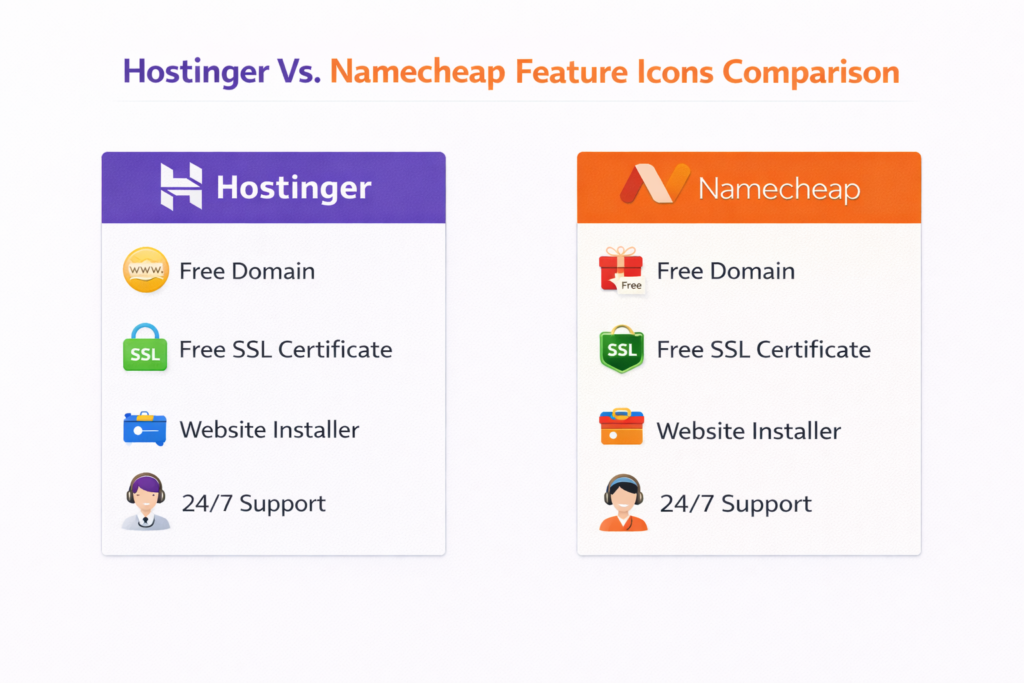
- Free SSL
- 24/7 customer service
The speed at which you can create websites, the ease of using those websites, and the value offered by the website hosting provider will all contribute to a better long-term experience with your website.
The following sections outline how Hostinger and Namecheap stack up against each other in terms of pricing, performance, features, support, etc., so that you are able to pick out the best web host for your web hosting needs in 2026 with confidence.
Hostinger vs Namecheap (Honest Comparison): Pricing, Speed & Features Compared
The differences betweenHostinger vs Namecheap can also be viewed through their pricing, speed of the website, and the features available to users when selecting a web host. Not only do each of these factors affect what users will spend on monthly service fees, but the way each of them will also affect how well their website performs, as well as what type of tools and resources will be provided to them to help build and grow their websites.
Cost Comparison
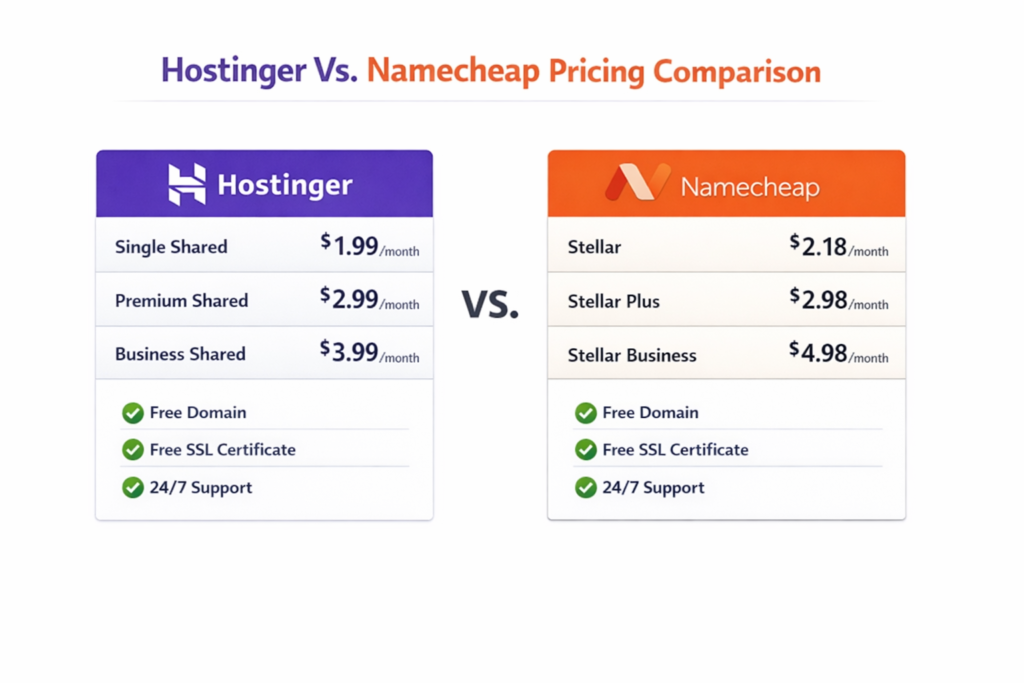
The first thing people generally look at when comparing Hostinger vs Namecheap is cost; both companies offer a variety of different plans at very affordable price points, but some differences between the two include:
Hostinger’s Pricing
- Low-cost first-time warranty prices (really low price)
- Lower than namecheap for first time
- Initial warranty increases may happen, but the increases are generally competitive
- With hostinger’s plans, level 3 plans have more features than any other level 1 by 3x:
Namecheap’s Pricing
- Namecheap also has a budget-friendly option (however, unlike Hostinger,
- Namecheap is generally more consistent between its initial warranty offerings and its renewal prices)
- Domain-related products are typically bundled with the lower-level version.
✅ Summary: For most users, Hostinger wins on initial cost and aggressive first-time warranty pricing, while Namecheap has a much clearer price of renewal for the lower-cost plan, particularly if they are also purchasing domains.
Speed & Performance
When comparing Hostinger vs Namecheap and how fast each web host is, speed plays an important role for both SEO and User Experience. In terms of speed and performance; Hostinger offers many benefits over Namecheap; for example, Hostinger offers optimized servers with LiteSpeed Cache support, global data centers to increase local load speeds, very good load speeds for both Shared Hosting and WordPress Hosting, etc., whereas Namecheap has solid load speeds for basic sites only with very little emphasis placed on implementing advanced caching and speed tools.
Depending on the plan you purchase from Namecheap will determine the speed and performance you receive. Independent testing and user reporting have shown that Hostinger’s average load speeds are typically faster than those of Namecheap, particularly for WordPress Hosting.
For a good comparison of the speed performance between Hostinger and Namecheap, refer to the image comparison chart below.
Features & Tools
Features can also play a key role in determining which of the two web hosts is right for you when deciding between Hostinger and Namecheap.
Examples of Hostinger Features Include:
- A custom control panel hPanel;
- Free SSL included on most plans;
- Daily/Weekly Backup (depending on the plan you purchased);
- A website builder on some plans,
- Optimization Tools for WordPress (Blogging) purposes.
Example of Namecheap Features Include:
- cPanel (standard for many web hosting providers and well known) ;
- Free SSL on select plans;
- Domain Privacy Protection included on plans (typically);
- Decent email hosting; Quick and
- Quick and Easy domain and web hosting integration.
Overall, Hostinger has a lot more built-in tools available, particularly in regards to Site Performance and WordPress Website Features, while Namecheap is successful in the way they integrate Domain Management and their ease of use.
Summary: Pricing, Speed & Features
| Criteria | Hostinger | Namecheap |
|---|---|---|
| Pricing | Lower introductory pricing | Predictable renewals |
| Speed | Faster with optimized infrastructure | Good for basic sites |
| Features | More built-in tools & performance features | Strong domain and email focus |
In the Hostinger vs Namecheap battle, Hostinger often wins on price (intro offers), speed, and modern features, while Namecheap shines in simplicity and domain management value.
Hostinger vs Namecheap: Full Comparison for Beginners & Growing Websites
There are many things to consider when deciding between Hostinger and Namecheap. Two of the most important factors for all new or smaller business websites are:
- How easy is it to use?
- What happens as my website grows?
In this article, we will cover everything you need to know about both providers from start to finish.
As a new website owner, ease of use and an easy setup process is vital.
Hostinger:
- Custom user control panel (hPanel) allows for intuitive navigation
- Easy installation of WordPress and other popular apps with one click
- Onboarding tutorials and helpful articles on how to use their platform.
Namecheap:
- cPanel layout (the industry standard for hosting providers) provides familiarity.
- Ease of set-up for domain + hosting combination.
- User-friendly, modern, clean control panel; easy to review pricing and extensions.
Summary: Hostinger is generally considered much easier for beginners to use because of its simple control panel user interface along with its onboarding process. While Namecheap is easy to use, it has a traditional cPanel-style layout rather than a modern style as does Hostinger.
For many website owners — especially beginners and small businesses — the Hostinger vs Namecheap debate comes down to two questions:
- Which host is easiest to use?
- Which one can grow with my website over time?
In this full comparison, we’ll break down what each provider offers at every stage of your website journey.
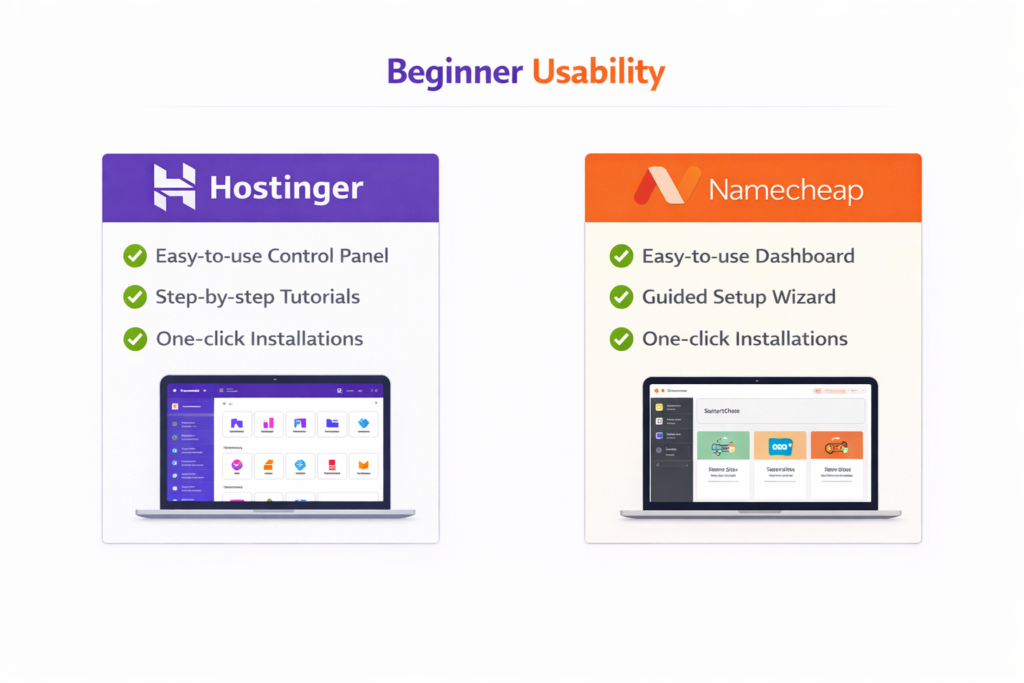
Best for Beginners
If you’re launching your first website, ease of use and simple setup are key.
Hostinger
- Custom dashboard (hPanel) that’s easy to navigate
- Guided setup and onboarding
- One-click installs for WordPress and other popular apps
- Helpful knowledge base and tutorials
Namecheap
- Familiar cPanel interface (solid choice if you’ve used hosting before)
- Simple domain + hosting combo setup
- Clean dashboard with clear pricing and add-ons
👉 Quick takeaway: Hostinger tends to be more beginner-friendly thanks to its simplified dashboard and guided onboarding. Namecheap is still easy, but its interface is more “traditional.”
Site Growth
As your website continues to accumulate more visitors and receive growing levels of complexity, a scaling web hosting platform will become necessary for continued success.
Hostinger’s Growth Options:
- Multiple upgrade plans are available to customers (Shared → Cloud → VPS).
- Features that improve the speed of your website include LiteSpeed Cache, Automatic Backups, etc.
- Plans optimized for WordPress provide opportunities for a speedy growth rate.
- Global data centres that allow the organisation to reach customers around the world quickly.
Namecheap’s Growth Options:
- Domain and email upgrading options are available.
- VPS hosting offers customers scalable options for resource management.
- Managed WordPress is offered (but with fewer options compared to Hostinger).
Quick Summary: Both Hostinger vs NameCheap allow for growth; However, Hostinger has more advantages that directly relate to growth, specifically for WordPress and performance.
Summary: Best for Beginners & Growth
| Needs | Better Option |
|---|---|
| Absolute beginners | Hostinger |
| Domain + hosting simplicity | Namecheap |
| Scalability & performance tools | Hostinger |
| Email + domain management | Namecheap |
When we compare Hostinger vs Namecheap, Hostinger tends to provide the best user experience and performance tools; whereas, if you are looking for the best way to manage your domains and have predictable renewals then choose Namecheap.
Hostinger vs Namecheap: Pros, Cons, and Which One You Should Choose
Many people looking for budget-friendly web hosting companies use Hostinger vs Namecheap to help them find an affordable option with lots of features. They are both popular choices in the web hosting market and offer similar products (shared hosting, domain name registration, etc.), but there are some differences between the two companies regarding performance, pricing, etc., and this guide will help you determine which web host best meets your needs.
Hostinger is a provider that specializes in inexpensive web hosting for all types of people. There are many features of Hostinger, including fast server speeds, an easy-to-use control panel, free SSL, and free domain names on specific hosting plans.
Namecheap started as a domain registrar and has now expanded into providing budget-friendly web hosting services. Namecheap is an excellent example of a provider that has created a user-friendly control panel interface, as well as a variety of solid features such as free SSL and free domain names with some plans.
Performance & Speed
Hostinger
- Has fast load times and solid WordPress performance using LiteSpeed web servers and typically NVMe SSD storage.
- Globally distributed servers help limit latency for users who live outside of the area where the data is hosted.
Namecheap
- Uses traditional setups, mainly Apache, for most of their services and standard SSDs for most of their service plans.
- While both are fairly good-quality, most results for speed and uptime show that Namecheap comes after Hostinger’s services.
Value Winner: Hostinger has proven to have the best speed and performance overall and offers a lot of value for WordPress sites.
Pricing & Value4
Both are great options for budget-conscious customers; however, there are some differences to note:
Hostinger
- Offers a very low introduction rate of $2.99/month+, which usually includes a lot of discounts for long-term agreements.
- However, renewal rates will generally be a lot higher. (This is something that is common among web hosts.)
Namecheap
- Has a relatively low initial price (usually a little lower than Hostinger) and has some plans that give you free domain privacy and SSL for the first year.
- If you have basic needs and you’re looking for predictability, Namecheap is a great choice for your long-term hosting needs.
Value Tip: Hostinger typically has a lot more features for the money, but it’s still advisable to look at renewal rates before making a long-term commitment.
Security & Backup Services
Hostinger
- Hostinger provides free SSL certificates and a plethora of built-in security options, including malware scans, on most plans.
- Automatic backups are included with certain plans.
Namecheap
- Namecheap’s free SSL certificates typically apply to the first year, as well as providing domain name privacy protection.
- The frequency of Namecheap’s backups is determined by the level of plan you purchase — only providing the most backup protection to their higher-tier plans.
Ease of Use & Support
Winner: Hostinger wins because the default security measures on Hostinger’s plans are stronger and provide more security.
Hostinger
- Hostinger has developed a custom hPanel that is very simple for beginners to use and manages everything very simply.
- They also provide 24/7 live chat support with quite fast response times.
Namecheap
- Namecheap provides cPanel, which is a control panel that many website developers and owners are familiar with.
- Support for Namecheap includes both live chat and ticketing but may have a slower response time in comparison to Hostinger.
Winner: It is a tie for ease of use. Hostinger provides great tools for beginners while Namecheap offers greater familiarity to creators and webmasters who use cPanel.
Pros & Cons — Hostinger
pros
- LiteSpeed+NVMe SSD means that the web hosting experience is quick.
- Hostinger provides many built-in features (like backup systems and free domain names offered as part of certain packages).
- The control panel provided by Hostinger is extremely user-friendly and the overall web hosting performance is excellent.
Cons
- Renewal prices can be significantly higher than the initial prices.
- Some advanced features are only available on more expensive tiers of web hosting.
Pros & Cons — Namecheap
Pros
- Entry-level packages are extremely inexpensive.
- Many namecheap packages come with domain privacy protection.
- The interface of cPanel is very easy to use and is what everyone in the industry uses for managing their websites.
Cons
- Entry-level packages do not include many advanced features.
- Although the speed and performance of namecheap has been rated above average, it’s still not the best.
Which One Should You Choose?
Choose Hostinger if:
- You want better performance and speed.
- You’re building a WordPress or business site that needs optimization.
- You want feature-rich plans with backups and staging tools.
- You prefer an easy onboarding experience for beginners.
Choose Namecheap if:
- Your priority is low cost and predictable pricing.
- You value domain services with privacy included.
- You’re comfortable with cPanel and traditional hosting setup.
Hostinger vs Namecheap — Which Is Cheaper, Faster, and More Reliable?
Selecting the appropriate web hosting service is a key factor in determining your website’s overall costs, speed, reliability, and uptime. Hostinger and Namecheap are two of the most popular hosting solutions for affordable services with significant differences in regard to performance and long-term values. The following list compares the two hosting solutions to figure out which is cheaper, faster, and more reliable based on certain important factors.
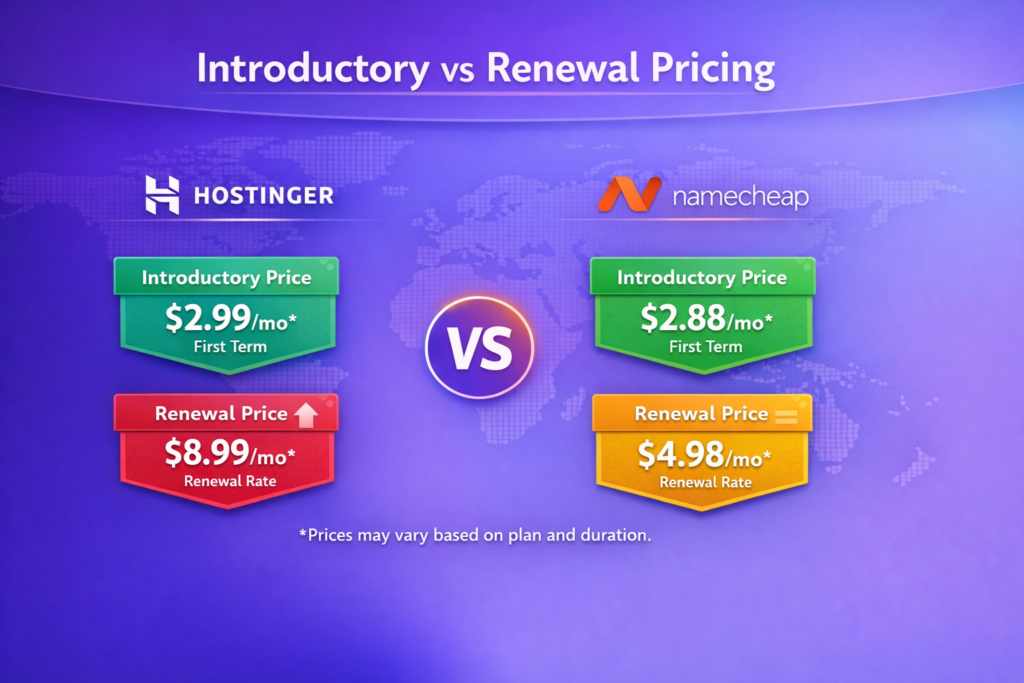
Pricing Breakdown Graphic: Visual representation of introductory vs renewal pricing.
Speed/Performance Chart: Comparison of upload speed and server response times.
Reliability Section Graphic: Uptime and infrastructure overview.
Cheaper – Hostinger vs Namecheap
Introductory Pricing
- Hostinger usually has lower promotional prices than Namecheap. In addition, shared hosting with Hostinger starts at an exceptionally low rate due to its longer term price structure (2-4 years) which is why it is cheaper at the time of sign-up.
- Both Hostinger and Namecheap offer competitive pricing, and on some of their plans, Namecheap starts with a slightly lower initial price. However, Hostinger has consistently offered higher discounts that tend to be temporary.
Renewal & Long-Term Pricing
After introductory pricing expires, Hostinger’s renewals can be significantly higher, while Namecheap’s renewal pricing will remain more stable; thus, if your goal is to keep costs down, consider Namecheap over Hostinger.
The long form contract may save you some money with Hostinger compared to Namecheap, but as there are no long form contracts with Namecheap and the renewal prices remain steady, the long term costs for Namecheap will ultimately be lower than those for Hostinger.
Speed: Speed Comparison Hostinger Vs. Namecheap
Hostinger’s use of NVMe SSD and LiteSpeed web servers provides its customers with quicker load time and response rate than Typical Hosting Providers that use standard SSD and Apache servers for their Shared Hosting Plans.
The speed tests conducted reveal that Hostinger is much quicker than Namecheap in all cases tested, with load times of between 0.6 and 0.8 seconds being the norms attributed to all Hostinger sites tested, while load times for comparable services provided by Namecheap are generally assessed to be between 1.2 seconds and higher.
The ability for Hostinger to have a quicker response rate (TTFB) and higher functionality for caching creates the possibility for Hostinger’s offering to be a more efficient means to host dynamic content such as WordPress.
More Reliable: Hostinger vs Namecheap
Uptime and Server Stability
- When it comes to comparing Hostinger’s and Namecheap’s reliability, particularly in terms of uptime and server stability, both Hostinger and Namecheap have a similar 99.9% uptime guarantee, which indicates that you should not expect many outages.
- When evaluated from an independent standpoint and based on user feedback, Hostinger has consistently shown up as having good uptime and superior capacity to manage spikes in website traffic.
- Namecheap’s uptime is also respectable, although it can be inconsistent for lower-level shared hosting customers, according to the feedback it received from users; there appear to be some fluctuations in performance (compared to Hostinger), occurring more frequently with lower-level plans.
Infrastructure & Global Reach
- Hostinger offers more geographical coverage by having more data centers located across the globe and by having CDN options included with many of its plans—this is beneficial for international users because they will experience lower levels of latency when accessing the Hostinger network.
- Namecheap does not have many of these globally distributed points of presence, so it is more likely that end-users located outside of the regions where their servers are located will experience slower speeds, and, therefore, have a lower level of reliability.
So in summary, Hostinger consistently demonstrates a superior level of uptime, a more extensive geographic infrastructure, and greater reliability than Namecheap, especially with regard to lower-level hosting plans.
Reliability Verdict:
Hostinger often edges ahead thanks to robust uptime, global infrastructure, and consistent performance.
Summary — Hostinger vs Namecheap
| Factor | Hostinger | Namecheap |
|---|---|---|
| Cheaper Upfront | ✅ Often with promos | ⚠️ Yes, but smaller deals |
| Cheaper Long-Term | ⚠️ Renewals can be higher | ✅ More predictable |
| Faster Performance | ✅ Yes (LiteSpeed + NVMe) | ⚠️ Decent but slower |
| Reliability | ✅ Strong uptime & global reach | ⚠️ Stable but variable |
| Best For | Speed-focused and growing sites | Simple, budget, domain needs |
Conclusion:
The decision of picking either Hostinger vs Namecheap is ultimately based on your level of experience, what your top priority is and your future direction.
Hostinger provides an all-in-one website solution for site performance and also has a low cost to get up and running quickly. Therefore it is ideally suited for the new blogger or small business owner who requires speed on shared hosting, a quick navigation panel to manage their business from, and good pricing that works well with an extended commitment for their hosting solution. Because Hostinger has put in place so many optimizations for speed with its dashboard, if performance is the most important consideration, Hostinger is a great option.
On the flip side, if you want an experience that is simple, clear and worry-free, and might want the ability to register several domains at once, then Namecheap is going to be a better option. Namecheap provides users looking for lower priced domains and basic web hosting and does so with a minimal amount of pressure to purchase additional items. With free WHOIS protection and a very accessible pricing structure, Namecheap caters to the software developer and those who prioritize their privacy.
In short:
- Hostinger is a better option for those looking for faster hosting, greater scalability, and a good host for new clients.
- On the other hand, Namecheap is a better choice for individuals who value domain names, want a more straightforward product, or need to have predictable and consistent pricing.
Both of these hosting companies are reputable and trustworthy. They both have their advantages and disadvantages, but it ultimately comes down to which provider meets your current and future website/networking needs the best.






One Comment