
LiveChat API Explained: Core Concepts and Real Use Cases 2026
What a LiveChat API Is and Why It Matters
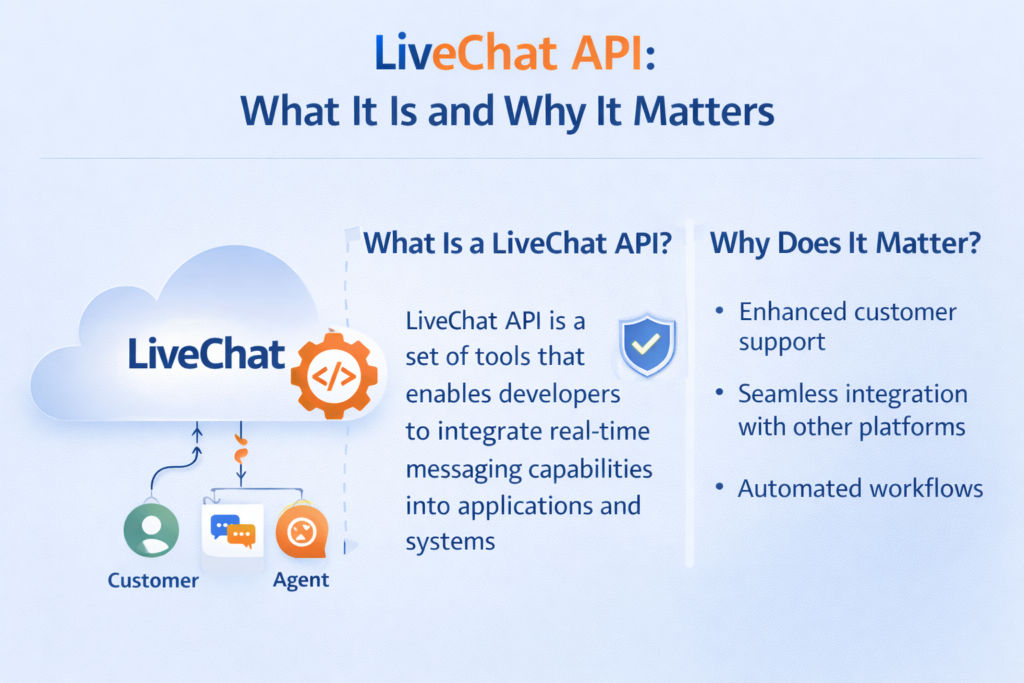
A LiveChat API is essentially a programmable layer that lets developers and businesses embed real time chat directly into websites, mobile applications, and internal tools. Rather than being limited to an off the shelf chat widget, an API approach gives teams deep control. Conversations can be created dynamically, routed intelligently, stored securely, and analyzed in detail. It becomes the connective tissue between customers, support agents, automation systems, and core business platforms, turning live chat into an integrated part of the broader digital environment instead of a disconnected feature.
Its importance becomes clear when you look at how people expect to communicate today. Customers want fast responses. They expect personalization. And they want the same experience no matter which channel they use. A LiveChat API makes this possible. It allows businesses to automate routine interactions, sync chat data with CRM systems, trigger workflows in real time, and scale support operations without slowing things down or lowering quality. At the same time, engineering teams gain the flexibility to tailor the chat experience, apply strict security controls, and evolve the system as needs change. Ultimately, a LiveChat API elevates live chat from a simple messaging box into a powerful, scalable communication layer that improves both customer experience and operational efficiency.
Core Concepts Behind LiveChat API Functionality
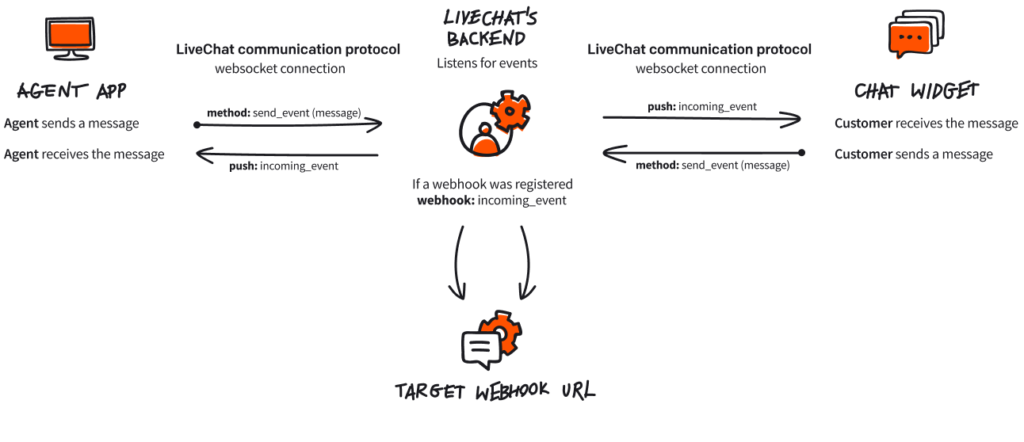
At its heart, a LiveChat API is far more than a simple messaging interface—it’s a powerful framework designed to enable real time, reliable, and highly structured communication between businesses and their users. Every interaction—whether it’s a short user message, a click, or a system-triggered event—is captured, processed, and delivered instantly to the intended destination. This event driven architecture ensures conversations flow naturally, while behind the scenes, routing logic, automation, and data tracking quietly orchestrate the system. Chat is no longer just a string of messages; it becomes a living, traceable object that can be monitored, updated, and analyzed throughout its lifecycle.
Integration stands as another fundamental pillar. A LiveChat API doesn’t exist in isolation; it is built to connect seamlessly with CRMs, help desks, analytics platforms, and internal business tools. Through secure authentication, precise endpoints, and event webhooks, chat data moves across systems in real time, enabling highly personalized interactions, automated workflow triggers, and contextual continuity across multiple channels. Layer in scalability and strong security measures, and the API becomes capable of supporting everything from small support teams to enterprise scale, high volume operations. The result is a communication system that is not only fast and reliable but also adaptable, intelligent, and deeply embedded within a company’s digital ecosystem.
How LiveChat APIs Enable Real-Time Communication
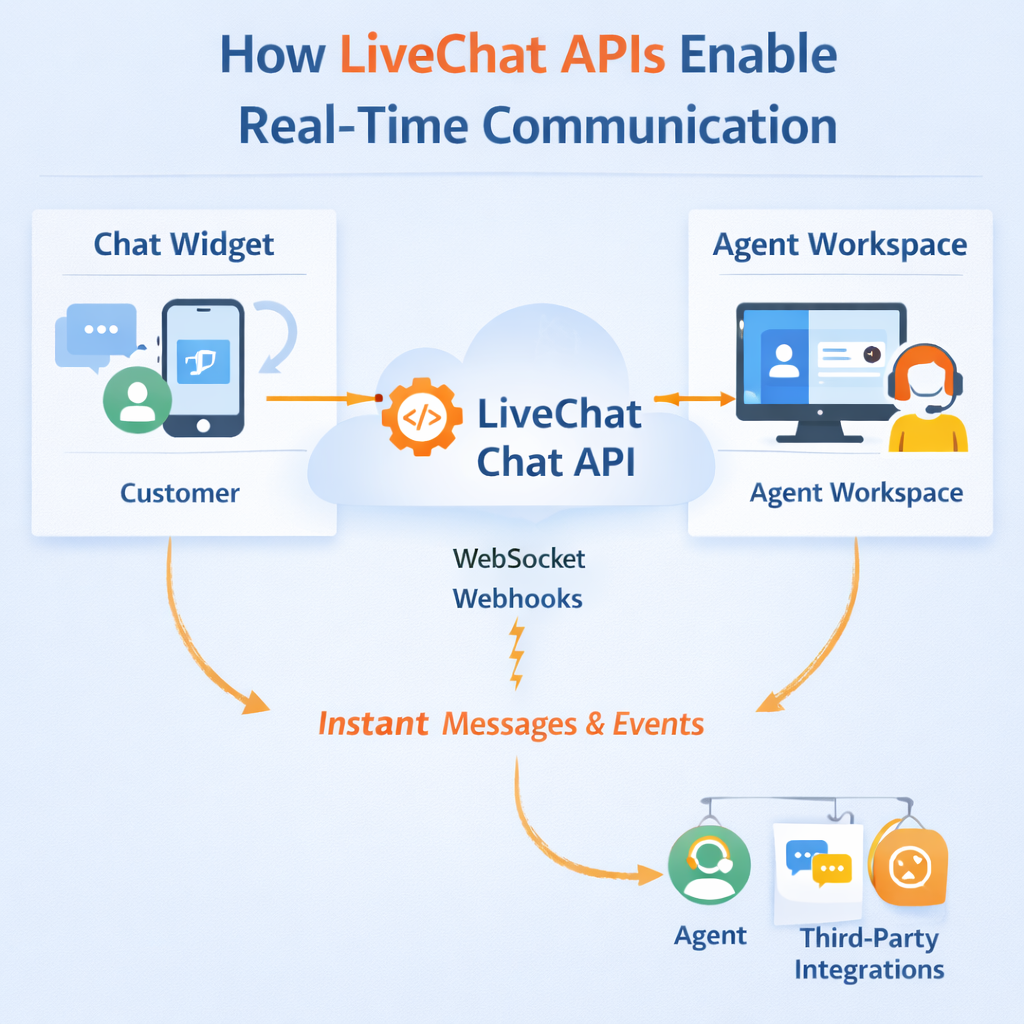
LiveChat APIs sit at the heart of modern digital conversations. They make it possible for businesses and customers to connect instantly, whether that interaction happens on a website, inside a mobile app, or across any other digital touchpoint. Quietly but powerfully, these APIs act as the connective tissue between what users see on their screens and the messaging infrastructure working behind the scenes.
At a functional level, LiveChat APIs expose the building blocks of real-time chat. They handle message delivery, conversation management, user presence, and intelligent routing to human agents or automated systems. A customer types a question. The API immediately carries that message to the server. From there, it may reach a support agent, trigger a workflow, or activate an AI chatbot. The reply comes back almost instantly. The delay is barely noticeable, and the exchange feels natural—like a real conversation rather than a technical transaction.
Speed, of course, is not accidental. Real-time responsiveness is achieved through technologies such as persistent connections and event-driven communication models. Instead of waiting for repeated requests, the system stays open and alert. Messages flow continuously. Typing indicators appear mid-sentence. Read receipts update without effort. Everything stays in sync, moment by moment, creating a fluid experience that mirrors face-to-face dialogue.
Beyond simple messaging, LiveChat APIs unlock powerful integrations. They connect chat tools with CRMs, ticketing platforms, analytics dashboards, and even payment systems. This means agents are no longer operating in the dark. They can see past interactions, understand customer context, and tailor responses on the fly. Issues get resolved faster, conversations feel more personal, and support becomes far more efficient.
Security and scalability complete the picture. Robust authentication, encrypted connections, and usage controls help safeguard sensitive data, while cloud-native architectures ensure performance holds steady—even when conversation volumes surge. Whether handling ten chats or ten thousand, the experience remains smooth.
Taken together, LiveChat APIs form the backbone of real-time digital communication. They enable fast, responsive, and context-aware conversations that meet modern customer expectations, all while helping businesses streamline engagement and deliver support that feels immediate, human, and effective.
Practical LiveChat API Use Cases in Modern Businesses
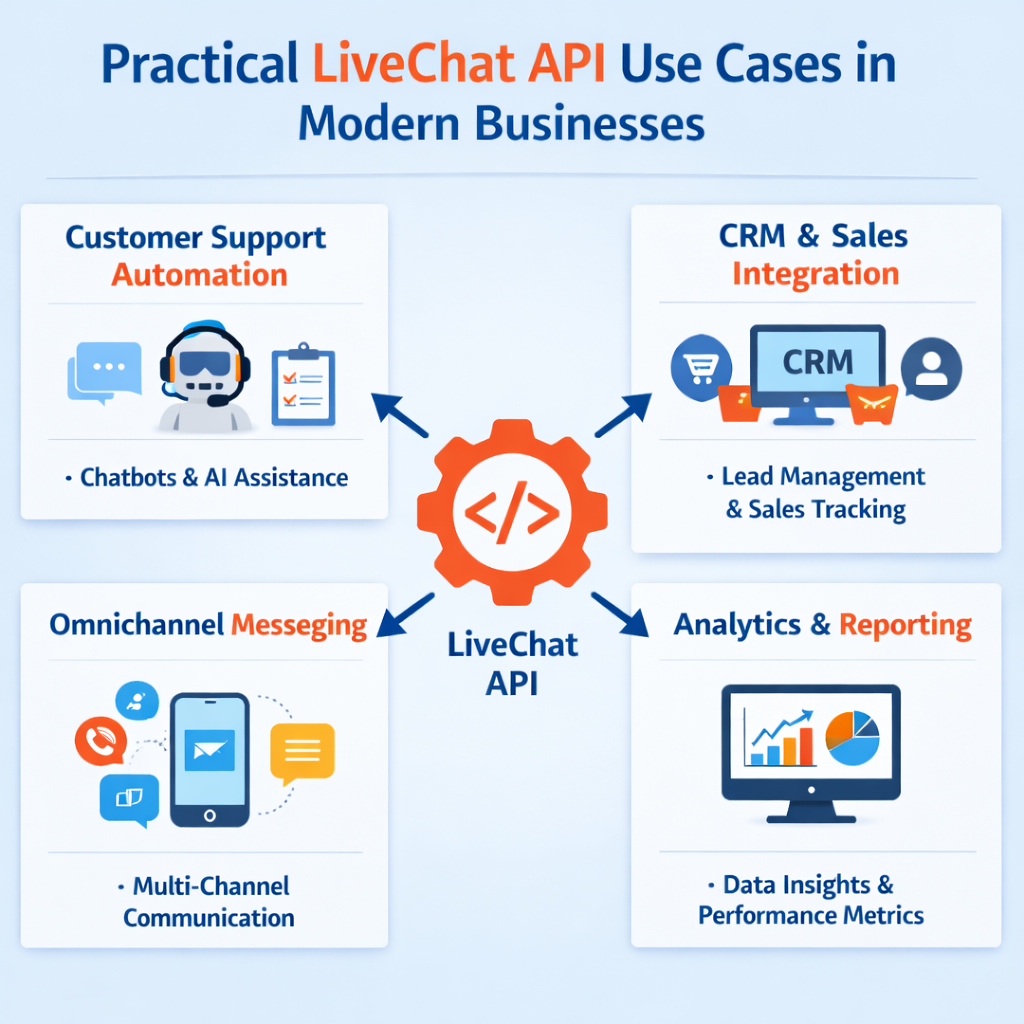
LiveChat APIs are no longer just pipes for passing messages back and forth. They have grown into flexible, powerful communication engines—systems that quietly support a wide spectrum of business operations while keeping conversations fast, fluid, and personal. In today’s always-on digital environment, organizations lean on these APIs to respond quicker, automate smarter, and meet customers exactly where they are.
Customer support is often where this evolution becomes most visible. LiveChat APIs can intelligently route conversations the moment they begin, assigning each chat to the most suitable agent based on skill, availability, or urgency. Simple questions? Those can be handled instantly by bots. Complex problems? Seamlessly escalated to human agents, without the customer ever feeling the handoff. The conversation continues. No friction. No repetition.
Sales teams benefit just as much—sometimes more. Embedded directly into websites and applications, LiveChat APIs allow businesses to engage visitors at decisive moments. A user hesitates on a pricing page. Another stalls during checkout. The API triggers a timely message, captures lead details, and syncs everything with a CRM. Sales reps step in already informed, already prepared. Timing, in this case, changes everything.
Onboarding and self-service experiences also gain momentum through live chat integrations. Instead of forcing users to navigate help centers or documentation, businesses can guide them in real time. Setup steps unfold inside the chat window. Feature walkthroughs feel conversational. Troubleshooting becomes faster, lighter, and far less frustrating. Knowledge bases and automation do the heavy lifting in the background.
E-commerce environments push these capabilities even further. LiveChat APIs support real-time product inquiries, order tracking, payment clarification, and delivery updates—all within a single conversation. Customers get answers when they need them. Confidence rises. Cart abandonment drops.
The use cases don’t stop at customers, either. Internally, companies rely on LiveChat APIs to power IT help desks, HR support, and operational dashboards. Employees get instant assistance. Teams collaborate faster. Bottlenecks shrink.
Finally, there’s insight. Every conversation holds data. LiveChat APIs make it possible to log, analyze, and categorize interactions at scale, revealing patterns that might otherwise go unnoticed. Common issues emerge. Opportunities surface. Decisions become sharper.
In the end, LiveChat APIs help businesses move beyond static, delayed communication. They enable real-time engagement, intelligent automation, and deep integration—turning everyday conversations into measurable value and meaningful outcomes.
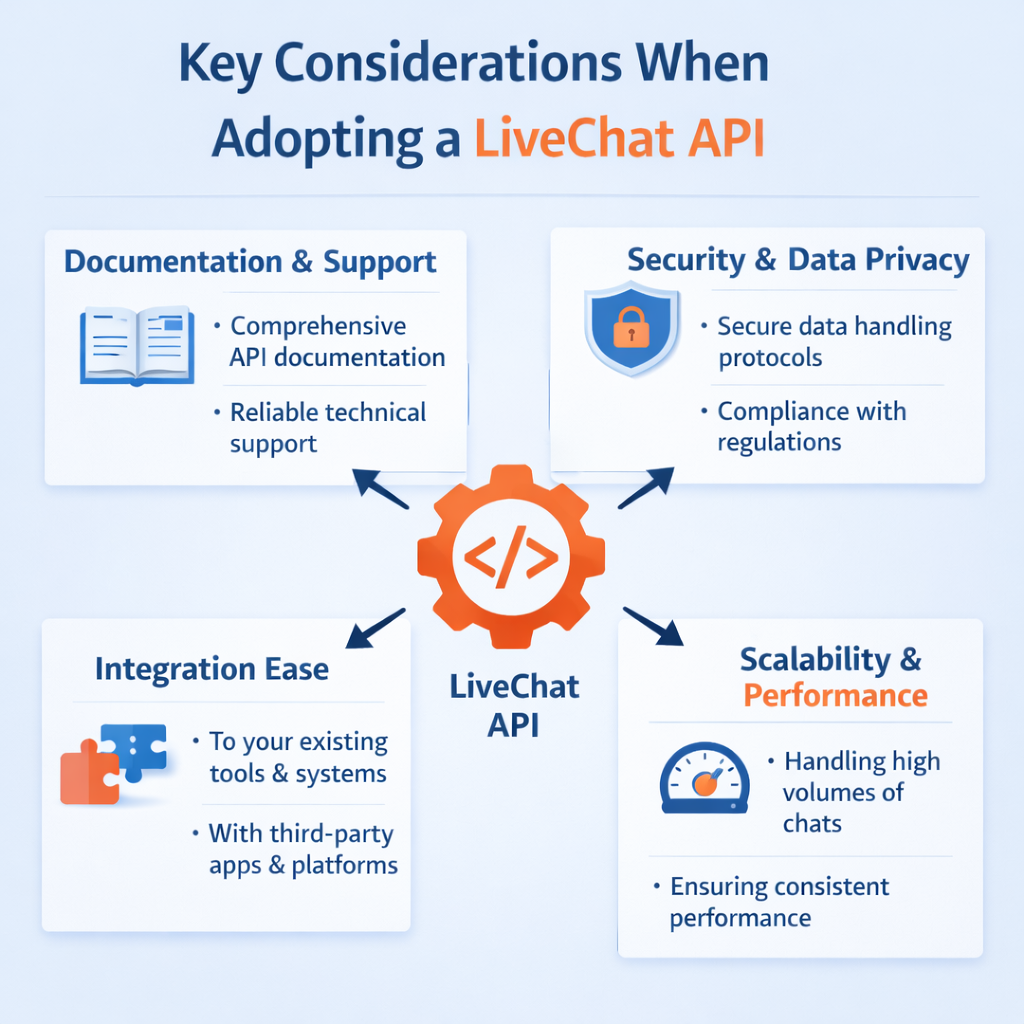
Key Considerations When Adopting a LiveChat API
Adopting a LiveChat API is not just a tech upgrade—it’s a game-changer. It can transform how your business talks to customers, sometimes overnight. But dive in blindly, and you risk chaos, bottlenecks, and wasted effort. The difference lies in careful planning, smart choices, and knowing exactly what matters.
Scalability. Small deployments can seem flawless. A handful of agents, moderate traffic—it works. But what happens when traffic spikes? Or when your user base doubles in a month? If the API can’t scale seamlessly, performance suffers. Conversations slow. Customers get frustrated. Trust erodes. True scalability is about more than capacity—it’s about keeping the system lightning-fast, no matter the load.
Integration is king. A LiveChat API rarely works alone. CRMs, help desks, analytics platforms, marketing automation—your tools must talk to each other. Without integration, agents scramble for context. Workflows stall. Data fragments. But with seamless connectivity? Everything flows. Conversations stay contextual. Operations stay smooth. Insight becomes actionable.
Real-time performance matters. Customers expect instant replies. Anything less feels like waiting, hesitating, or failing. Evaluate message delivery, connection stability, and failover scenarios. One dropped message can break trust. One laggy response can erode engagement. A reliable, consistent API makes conversations effortless, almost invisible—until something goes wrong, and then it’s ready to recover instantly.
Security and compliance cannot be ignored. These APIs handle sensitive data—personal info, transactions, sometimes critical account details. Encryption, authentication, and access controls are mandatory. And if your business is regulated—finance, healthcare, or others—compliance isn’t optional. A misstep can cost money, reputation, or even legality.
Customization and flexibility. Your business is unique. Why settle for a rigid API? Interface design, routing logic, automated workflows—your API should bend to your needs. Flexible tools let you craft experiences tailored to your audience. Inflexible ones force workarounds, slowing innovation and adding hidden costs.
Developer experience and support. Documentation, SDKs, stable versions, responsive support—these are not extras; they define success. A tricky API delays projects. Frustrated teams waste time. Bugs linger. Technical debt grows. A well-supported API accelerates implementation, reduces errors, and lets your team innovate instead of firefight.
In the end, adopting a LiveChat API is more than technical—it’s strategic. Consider scalability, integration, performance, security, flexibility, and developer support. Do it right, and your business gains real-time communication that’s reliable, intelligent, and context-aware. Do it wrong, and it’s just another frustrating tool. The choice is yours.
conclusion
The LiveChat API provides an extensive range of functionality and features that help businesses communicate in real-time with their customers and automate their customer interactions while providing additional integrations with existing systems. By learning about each of the concepts surrounding the Live Chat API—such as Messaging Flows, Webhooks, and Integrations—organizations CAN use this information in conjunction with the API to improve Customer Support, enhance Operational Efficiencies, and acquire useful analytical data. There are many examples of “real-world” applications (chatbots, CRM Integration) demonstrating how the LiveChat API improves both the Customer Experience and Workplace Efficiency, making it a key component of modern day Customer-Centric organizations.






One Comment